ASO School
You can learn about ASO, App marketing, app store optimization and app promotional strategies here and gain the latest app market news and analysis. Helping you to carry out app store optimization and promote app data growth.
How ASO and ASA Work Together: From Search Term Validation to Organic Growth
Many teams are already running Apple Ads while investing in ASO, yet the data from the two channels never truly connects.
The ASO team tracks keyword coverage and organic rankings. The paid acquisition team focuses on bids, CPA, and budget. As a result, advertising generates real search data every day without feeding it back into metadata, while changes to titles, keywords, screenshots, and product pages are made without validating whether users actually search, tap, and install.
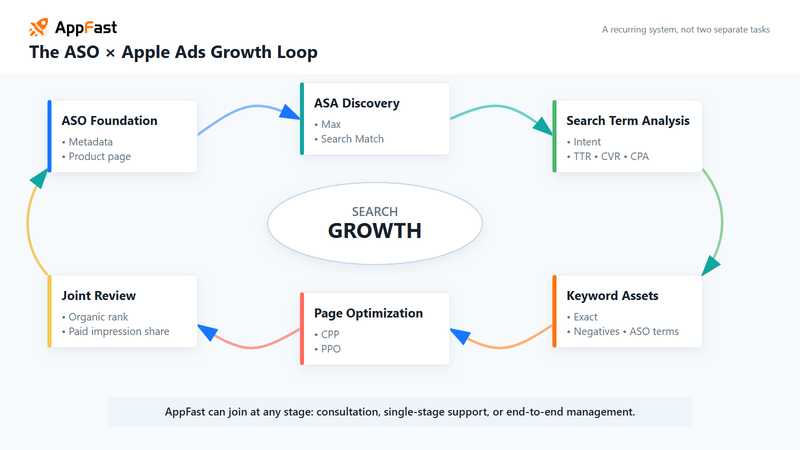
Based on years of campaign management, AppFast sees ASO and ASA not as two parallel workstreams, but as one continuous search growth system.
ASO builds relevance and conversion readiness. ASA secures visibility, validates demand, and accelerates data collection. Search terms, tap-through rate, and conversion rate from paid campaigns then inform the next round of keyword, metadata, product page, and campaign decisions.
Building this loop matters more than any isolated bid increase or budget cut.
Before Scaling Spend, Confirm That ASO Can Convert the Traffic
When campaign performance is unstable, the bid is not always the real problem.
Apple explains that ad relevance is influenced by an app's title, description, keywords, and other App Store signals. If relevance is weak, a high bid alone may still fail to win meaningful exposure.
Before increasing budget, review the fundamentals:
- Does the title and subtitle clearly communicate the app's primary use case?
- Does the keyword field cover valuable terms that do not fit naturally in visible metadata?
- Do the selected keywords accurately reflect the app's real functionality?
- Do screenshots and product pages fulfill the expectation created by those keywords?
- Is each market's metadata localized around local search behavior, rather than simply translated?
Before changing the title, subtitle, or keyword field, use AppFast's keyword coverage checker to review current coverage and identify obvious gaps. Then decide which terms belong in metadata and which should remain in ASA testing.
A keyword that converts well does not automatically belong in the title or subtitle. Metadata must remain readable, credible, and visually coherent. If a valuable term makes public-facing copy awkward, test it in the keyword field instead of forcing it into visible text.
AppFast can assess metadata quality before or during an active campaign. By combining long-term campaign experience, search term performance, and organic ranking observations, we identify whether the main constraint is weak keyword coverage, unclear positioning, or a product page that fails to match search intent.
Teams that are unsure whether to fix ASO, rebuild the keyword pool, or restructure campaigns can also start with a free consultation. The goal is to identify the bottleneck before more budget is spent against an unprepared foundation.
Build an Industry Keyword Pool Before Assigning Terms to ASO or ASA
A keyword pool that supports long-term growth cannot rely only on direct translation, competitor names, or suggestions from a single keyword tool.
A practical starting point is to organize terms by search intent:
- Core feature terms that directly describe the app's primary function;
- Use-case terms that reflect the situations in which users need the app;
- Broad category terms with higher traffic but wider competition and intent;
- Competitor terms that indicate comparison or replacement intent;
- Brand terms that protect branded search entry points;
- Long-tail terms with lower volume but potentially clearer demand;
- Irrelevant or low-value terms that inform negative keyword decisions.
If you already have core terms but lack use-case and long-tail coverage, use AppFast's keyword expansion tool to generate candidate directions, then filter them by relevance and ASA performance instead of adding every suggestion directly to campaigns.
The same keyword does not necessarily belong in both ASO and ASA. Organic coverage must account for limited metadata space, readability, and long-term positioning. Paid campaigns can validate much faster whether a term generates impressions, taps, and installs.
AppFast uses a large, continuously expanding search term database to uncover category language, long-tail demand, and local phrasing across markets. We then filter terms by meaning, competition, and historical campaign behavior, assigning them to metadata, Max, Search Match, broad match, exact match, or negative keyword structures.
The result is not a static spreadsheet. It is a search demand asset that improves as more campaign evidence becomes available.
Use ASA to Secure Search Visibility and Validate Real Demand
Apple Ads search results ads can appear at the top of search results or farther down the page. Eligibility depends on both relevance and auction competitiveness, so raising the bid alone does not solve every delivery problem.
This is why ASO readiness and ASA execution must be managed together.
Within the account structure, Max, Search Match, and exact match have different roles.
Max combines automated bidding with Search Match to pursue as many tap-through conversions as possible within a target CPA. It is useful for expanding discovery, but it still requires active control over search quality and budget allocation.
Search Match uses App Store metadata, information about similar apps, and other search signals to discover relevant queries automatically. It helps identify language that a manually built keyword list may have missed.
Exact match is the most important long-term output of the discovery process. Search terms should move into exact match only after relevance, conversion, and cost have been validated. Exact campaigns then provide more deliberate control over bids, exposure, and budget.
In one anonymized account, more than 400 search terms were reviewed. Roughly 25 became exact-match candidates and around 20 became negative keyword candidates. The remaining terms were not automatically worthless; many simply lacked sufficient volume, showed mixed intent, or had not yet earned independent management.
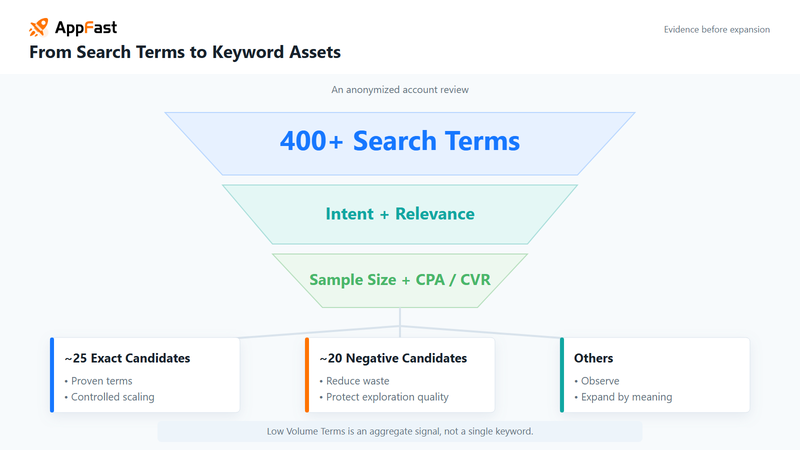
This is the difference between AppFast campaign management and routine bid adjustment. We do not only decide whether today's bid should move up or down. We turn campaign results into reusable keyword assets for the next growth cycle.
Diagnose Performance Through the Impression-to-Install Funnel
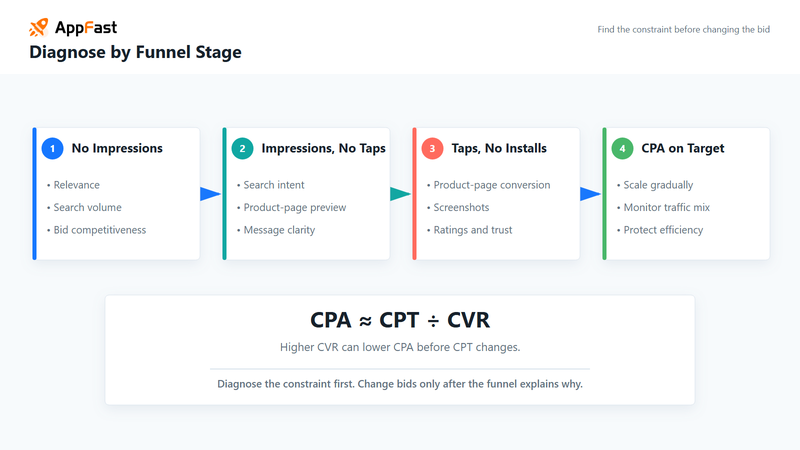
ASA optimization should not begin and end with CPA. A better approach is to diagnose each stage of the user's path from search to install.
When there are no impressions, check search volume, app relevance, bid competitiveness, and market scope. Even a strong bid may not generate delivery when relevance is insufficient.
When impressions are available but tap-through rate is low, examine whether the query matches the app and whether the default product page or custom product page reflects what the user expected. Raising bids at this stage may only amplify low-quality exposure.
When taps are available but conversion rate is low, the issue is usually closer to the product page. Review the icon, screenshots, ratings, first-screen message, and whether the page actually fulfills the promise implied by the keyword.
Only after installs and CPA meet the target should the campaign move into impression-share expansion, higher bids, and larger budgets.
For tap-through attribution, the relationship can be approximated as:
`CPA ≈ CPT ÷ CVR`
If traffic quality and CPT remain broadly stable, a higher product page conversion rate normally reduces CPA first. That does not mean CPT will fall by the same amount.
Apple states that actual CPT is dynamically determined by factors including ad relevance, the advertiser's bid, competing bids, the overall user experience, and the auction floor. Stronger tap-through rate and relevance can improve auction competitiveness, but Apple does not publish a fixed ranking formula such as `CPT × TTR`, and sustained delivery cannot guarantee a lower CPT.
AppFast evaluates metadata, impressions, TTR, CPT, CVR, CPA, and search term quality together. This prevents teams from using higher bids to conceal a relevance or product page problem.
Feed ASA Search Terms Back into ASO
The search term report is not only a source of negative keywords.
Real queries answer three questions that ASO alone cannot resolve with confidence:
- Do users actually search with this phrase?
- Are they willing to tap after seeing the app?
- Do they install after reaching the product page?
In practice, use the keyword coverage checker to see whether validated search terms are already represented in metadata, then use the keyword expansion tool to discover related terms around high-converting intent.
When a search term repeatedly produces valuable conversions, determine where it should go next:
- Move it into exact match for controlled, sustained delivery;
- Add it to the title, subtitle, or keyword field where appropriate;
- Build a custom product page around the underlying intent;
- Use it as a semantic direction for further keyword expansion;
- Keep it in discovery while more evidence accumulates;
- Add it as a negative keyword when it consistently wastes spend.
Low Volume Terms should not be treated as a specific query. Apple's public documentation does not disclose the exact threshold behind this aggregated label, so it cannot be converted directly into an exact or negative keyword.
A more reliable approach is to evaluate the aggregate CPA and CVR of low-volume traffic, then use visible related search terms to identify semantic patterns. If a low-volume cluster converts well, AppFast's internal expansion tools and search term database can build a focused set of related terms around that meaning instead of trying to manage the aggregated label itself.
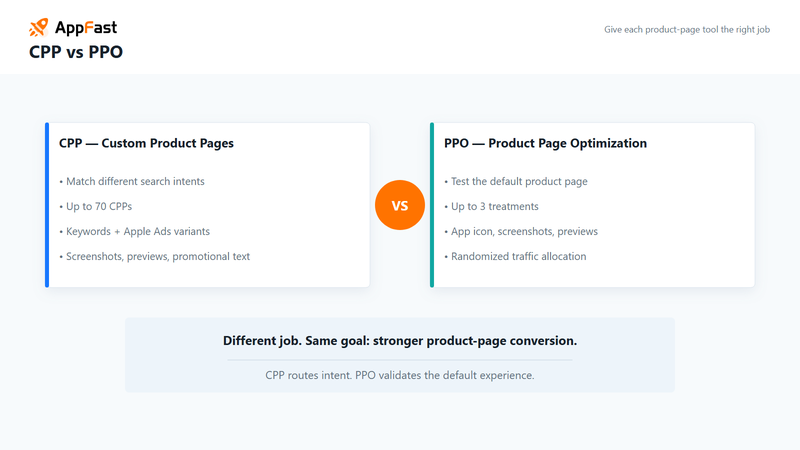
CPP and PPO Solve Different Problems
Custom product pages and product page optimization are often discussed together, but they solve different problems.
CPP answers: Which page should a specific search intent see?
Apple currently allows up to 70 custom product pages per app. Each page can use different screenshots, app previews, and promotional text. A CPP can also be associated with keywords or used as an Apple Ads ad variation.
Two keyword groups may both be relevant while representing different motivations, such as efficiency and privacy. Showing both groups the same page is not always the best choice. CPP allows each intent to reach a page whose message and creative match what the user searched for.
PPO answers: Which version of the default product page performs better?
Product page optimization can test up to three treatments using alternative icons, screenshots, and app previews. Traffic is randomly distributed, and performance is evaluated through conversion lift and confidence. PPO applies to the default product page, not to custom product pages.
In short:
- CPP assigns different pages to different user intents;
- PPO experimentally improves the default page;
- ASA search terms provide the intent and conversion evidence that guide both.
AppFast combines keyword classification, TTR, CVR, and search term performance to recommend product page changes. After a page is updated, campaign data is used to determine whether conversion improved among the intended audience rather than merely because the traffic mix changed.
Why Paid Placement Can Still Matter When Organic Rank Is Strong
A strong organic rank usually indicates that the app has accumulated relevance and performance for a keyword. However, rank alone does not prove the amount of organic conversion, nor does it automatically justify turning ads off.
Paid and organic placements appearing together can expand total visibility and reduce the chance that a competitor captures a valuable search entry point. For highly relevant terms with strong organic conversion, the actual cost of defending the paid position can also be more efficient.
In some accounts, AppFast has observed an app's organic position move temporarily to around the top ten while the app receives ad impressions. This may reflect the system testing how users behave after an ad is shown, but Apple has not publicly confirmed such a mechanism. It should therefore be treated as an account-level observation, not a universal rule.
To determine whether ads create incremental value, review multiple signals together:
- Impression share for the top ad placement and all available ad placements;
- Ad taps and tap-through installs;
- View-through installs;
- Organic keyword rankings;
- Changes in total downloads;
- Traffic composition before and after campaign changes.
Apple Ads reports tap-through and view-through installs separately. The tap-through attribution window is 30 days. A view-through install occurs when a user sees an ad, does not tap it, and downloads the app within one day.
A view-through install should not simply be labeled an organic install, but it can help analyze whether ad exposure influenced a later download.
Make Decisions in Stages Instead of Waiting for Every Metric to Mature
Search terms accumulate data at different speeds. Once a term has crossed a meaningful decision threshold, there is little value in waiting for every metric to reach a large sample.
AppFast uses staged operating baselines in account management:
- At 100 impressions or fewer, the term usually remains in data collection;
- Above 100 impressions and 5 taps with no installs, reduce the bid, pause the term, or consider it for a Max negative keyword;
- With at least 2 installs and CPA on target, test a 10%–20% bid increase;
- With at least 3 installs and CPA at or below 80% of target, test a 20%–40% bid increase;
- For competitor or category terms with limited impressions but clearly strong CVR, expand cautiously and validate.
These figures are AppFast's internal campaign baselines, not universal Apple rules. Each decision still depends on market size, keyword type, target CPA, downstream user quality, and available budget.
For Max, Apple recommends allowing at least two weeks before changing the target CPA so the system has time to learn. That does not mean the account must remain untouched for two weeks. Clearly irrelevant search directions, abnormal budget consumption, and low-quality traffic that has already crossed a decision threshold can still be controlled through budget, negative keywords, and campaign structure.
Core-Market Depth and Global Expansion Require Different Granularity
The same keyword and campaign structure should not be copied mechanically across countries.
When the total budget is small, the target markets have limited populations, and their audiences, languages, and conversion behavior are similar, grouping countries can prevent each campaign from becoming too fragmented to learn.
If countries differ materially in CPA, CVR, budget scale, language, or search intent, they should be managed separately. Otherwise, strong performance in one market can hide wasted spend in another.
AppFast brings years of hands-on ASO experience to both growth directions:
- Deep optimization of metadata, keywords, product pages, and bids in major core markets;
- Phased validation of additional countries to build a broader global keyword and acquisition footprint.
Global growth is not the act of translating one keyword list into several languages. It requires rebuilding the list around local phrasing, competition, user intent, and actual campaign performance.
AppFast Can Join at Any Stage
Not every team needs full-service campaign management from day one.
Before launch, AppFast can provide a free consultation, metadata quality assessment, industry keyword pool development, and campaign preparation.
For accounts already spending, we can begin with an account audit, search term analysis, exact and negative keyword consolidation, bid optimization, or country structure review.
When product page conversion is the constraint, teams can engage AppFast specifically for ASO, CPP/PPO, and keyword-to-page alignment.
When expansion is the priority, we can optimize priority countries in depth or design a phased global market validation plan.
Teams can choose a single service stage or use AppFast's full managed-service loop:
Metadata diagnosis → Industry keyword pool → ASA execution → Search term analysis → Exact-match consolidation → Product page optimization → Paid and organic performance review → Next optimization cycle
AppFast does not require every team to buy the same fixed package. We begin at the point where the current growth system is breaking. The keyword classifications, search term findings, metadata recommendations, and campaign decisions produced during the engagement remain reusable assets for later growth.
The Goal Is a Continuous ASO and ASA Decision System
ASO should not optimize only for keyword coverage, and ASA should not optimize only for the lowest short-term CPA.
The effective sequence is to use ASO to establish relevance and conversion readiness, then use ASA to secure search exposure and collect real demand signals. Proven search terms move into exact match, metadata, and product pages. Organic performance and total conversions then determine how paid budget should be reallocated.
Once this loop is operating, campaign spend produces more than installs. It creates a continuously improving understanding of how users search, why they tap, why they install, and which markets deserve further investment.
Whether an app is preparing to advertise, already spending, or entering new countries, the team can begin with a free AppFast consultation. We first identify whether the main constraint lies in metadata, keywords, campaign structure, product pages, or market allocation, then provide a focused, phased, or fully managed service based on the actual need.