
ASO School
You can learn about ASO, App marketing, app store optimization and app promotional strategies here and gain the latest app market news and analysis. Helping you to carry out app store optimization and promote app data growth.
Core Keyword Optimization Techniques: Significantly Enhance the Discoverability of Apps and Games
2026-02-09
Meta description:This article provides an in-depth analysis of keyword optimization strategies for apps and games, covering everything from keyword selection and layout to metadata pairing. By combining practical tactics, it shows you how to enhance your app’s discoverability through keyword optimization, while also sharing tips for continuous optimization to help developers improve their keyword rankings and drive download growth.
Why Keywords Are the Core of App and Game Discoverability
The mobile app and gaming market has entered a phase of stock competition. Over 65% of users discover new products by searching in app stores, and the core of this search behavior lies in keywords. Even if a product boasts outstanding features and user experience, a lack of precise keyword strategy can prevent target users from finding the product through search, making it difficult to achieve download conversions.
App store algorithms determine search rankings based on keyword relevance, popularity, and user behavior data; the higher the ranking, the greater the exposure. At its core, keyword optimization is about achieving a precise match between your product and users’ search intent, enabling you to seize prime search placements. This is the most direct and efficient way to enhance your app’s discoverability and serves as the key lever for all product categories to acquire organic traffic at low cost.
Method for screening high-value keywords: Avoid the red ocean and lock in precise traffic
Screening keywords that are well-suited to your product is the core first step in keyword optimization. The pain point for most developers is either blindly choosing popular, high-volume keywords that are hard to rank for, or selecting obscure keywords with no search volume and thus no actual traffic. To screen out high-value keywords that “have traffic, low competition, and high conversion,” you need to follow the principle of “tool-based mining + dimensional analysis + alignment with your product.” The specific practical approach is:
-
Leverage professional tools to mine a keyword pool
-
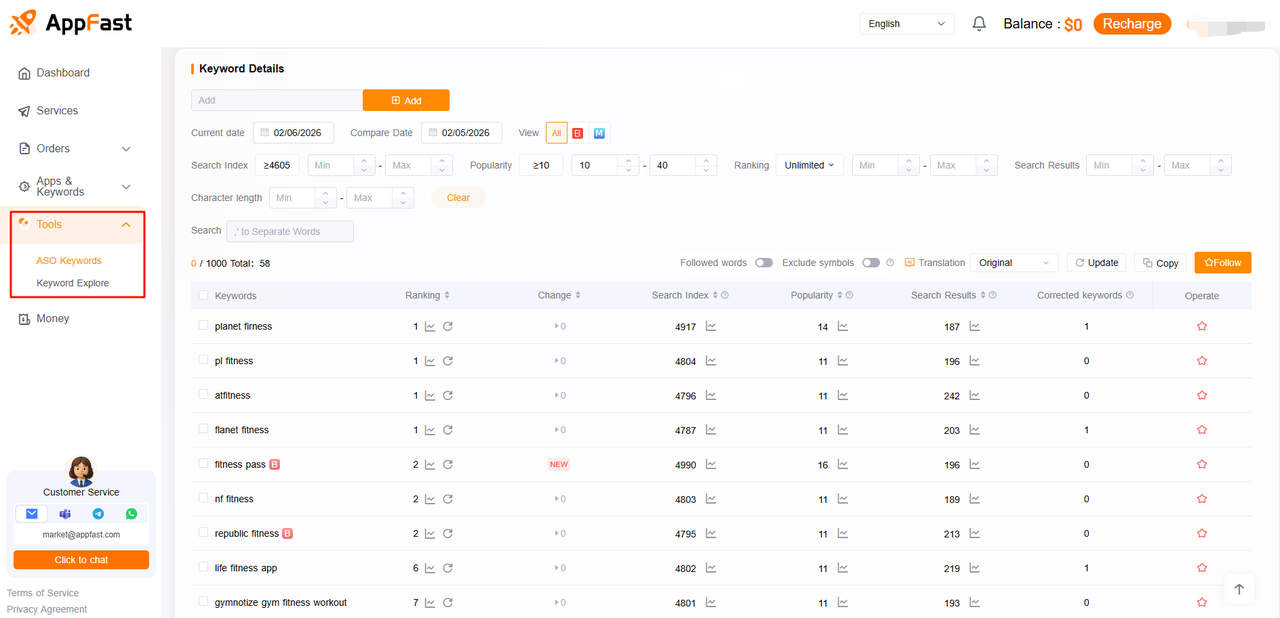
Professional data analysis tools can precisely capture keyword data from app stores, breaking free from the limitations of subjective judgment. With APPFAST, you can filter keywords by target product.
-
During filtering, you can use quantifiable metrics such as the search index and popularity to lock in blue-ocean keywords, quickly identify high-potential keywords with traffic and low competition, and build a preliminary keyword pool.
-
Filter keywords from three core dimensions
-
After mining the keyword pool, we eliminate invalid keywords by considering relevance, competitiveness, and conversion potential, while retaining precise keywords. These three dimensions serve as the core criteria for screening and are all indispensable.
-
Relevance is fundamental: keywords must align with the product’s core features, gameplay, and selling points. Avoid using irrelevant keywords, as they can lead to a high user bounce rate and harm algorithmic weighting.
-
The level of competition should be moderate. Avoid broad, high-volume keywords in general categories such as “game” and “notes,” and instead prioritize niche-demand keywords and category-specific terms to reduce competition while reaching users with precise intent.
-
Focus on conversion potential: Some low-search-volume keywords have extremely strong conversion potential, enabling direct reach to highly targeted users who are willing to pay, making them more valuable for marketing than generic terms.
-
Adjust keyword selection strategies based on the product stage
-
Newly launched products primarily target long-tail keywords, making it easier to quickly achieve high Rankings, accumulate initial traffic, and gather user behavior data.
-
For products with a certain foundation, gradually incorporate moderately popular core keywords to steadily increase product exposure.
-
For mature products, you can experiment with a small number of popular broad keywords and pair them with long-tail keywords to create a keyword matrix, enabling comprehensive traffic coverage.
If you don’t know how to filter high-value keywords based on your own products, you can try our APPFAST from DianDian Data.Keyword coverage serviceLeveraging professional data tools and industry expertise, we tailor a dedicated keyword pool for you, precisely pinpointing the traffic entry points best suited for your products, so your apps and games can quickly gain search visibility.
Scientific layout of keywords: Leveraging weighting rules to enhance matching efficiency
After filtering out high-value keywords, proper layout can maximize the utility of these keywords. App store algorithms assign distinct weights to different metadata positions: the earlier characters appear in a given position, the higher their weight. You must follow the principle of “weight first, natural integration, avoid keyword stuffing” by placing keywords in each core position while also ensuring readability and avoiding over-optimization that could lead to rejection during review. The specific layout method is as follows:
-
Product Name: Highest-Weighted Position – Core Keywords Must Be Strategically Placed
-
The product name is the metadata position with the highest weight and is the field that the algorithm prioritizes for matching. We recommend using the format “Brand Name + Core Keyword,” with a character limit of 30 for iOS and 50 for Google.
-
It ensures brand recognition while enhancing keyword match accuracy, allowing users to instantly grasp the product’s core value and enabling precise placement of core keywords.
-
Subtitle/Brief Description: Supplement keywords to reinforce product selling points.
-
The subtitle’s weight is second only to the product name, making it the ideal place to supplement secondary keywords and highlight differentiated selling points—no need to cram in keywords.
-
In a single sentence, combine core features, user pain points, and keywords, prioritizing conversion while using weighting as a secondary factor, to achieve effective conversion from impressions to clicks.

-
Keyword bar: Fully leverage the character limit to expand your reach.
-
The keyword field in the iOS system has a strict limit of 100 characters. Use English half-width commas to separate keywords without spaces; this is a crucial area for expanding keyword coverage.
-
When laying out the content, avoid repeating product names and subtitle keywords. Prioritize including uncovered long-tail keywords and niche category terms, while refraining from overusing competitors’ trademarked terms to prevent rejection during review.
-
The Google system does not have a dedicated keyword field, but you can naturally incorporate keywords into the short description and detailed description to achieve a comparable coverage effect.
-
App Description: Seamlessly integrate keywords to boost download conversions.
-
The app description directly influences users’ download decisions. The first two lines of content are displayed directly in the app store and require particular attention to detail.
-
Start with a sentence that clearly highlights the product’s core value and directly addresses users’ pain points. Subsequently, break down the content into sections to list features, gameplay options, and advantages, naturally incorporating keywords while avoiding technical jargon and forced keyword stuffing.
Keyword Optimization and Metadata Synergy: Turning Discoverability into Downloads
The core goal of keyword optimization is to enhance app discoverability, which ultimately needs to translate into actual download volume. To achieve this, keyword optimization must be deeply integrated with metadata optimization. Metadata includes textual information as well as visual assets such as icons, screenshots, and preview videos. Visual assets directly influence users’ willingness to click, while user behavior data—such as click-through rates and download volumes—in turn feeds back to influence keyword Rankings, creating a positive feedback loop. The specific collaborative optimization approach is:
-
Key Points for Visual Asset Optimization
-
The icon should be simple and clear, with strong color contrast, highlighting the product’s core features or the game’s core style. Use intuitive symbols and colors to convey the product’s attributes and enhance user recognition. If you want to take a personalized approach, consider visualization: for example, Huolala’s icon is a truck graphic, QQ Mail is an envelope, WeChat is two chat bubbles, and TikTok is a music symbol.

-
The first two screenshots must directly address users’ pain points, showcasing the core features and gameplay, paired with concise copy to quickly help users understand the product’s core value.
-
Create 15–30 second preview videos to quickly demonstrate the operation process and core highlights, and add a call to action such as “Download Now” at the end of the video to guide users toward conversion.
-
Optimize metadata conversion performance with A/B testing
-
Leverage the app store A/B testing feature to compare the conversion performance of different icon, screenshot, and description versions, and based on user behavior data, select the optimal metadata configuration.
-
For gaming apps, you can test the conversion performance of different screenshots, such as “character showcases” and “gameplay demos.” For utility apps, you can test the click-through rates of different copy variations, enabling more targeted metadata optimization.
Continuous optimization of keywords: Make dynamic adjustments to stay competitive
Keyword optimization is not a one-time effort; it’s an ongoing process of continuous monitoring, analysis, and adjustment. Updates to app store algorithms, changes in user search behavior, and adjustments to competitors’ strategies can all impact keyword rankings. A static keyword layout will inevitably lead to traffic loss. To ensure that your keywords remain competitive at all times, you need to establish a normalized optimization mechanism and focus on three key areas:
-
Real-time monitoring of keyword rankings and DianDian Data
-
With the help of ASO tools, monitor in real time the Rankings, search volume, click volume, download volume, and other data of core keywords; data serves as the core basis for optimization and adjustments.
-
Strengthen the placement of keywords with rising Rankings and strong conversion performance; promptly replace underperforming keywords with declining Rankings and falling search volume; and quickly deploy strategies for trending keywords experiencing a rapid surge in search volume to seize traffic opportunities ahead of the competition.
-
Adjust keywords based on product updates and market trends
-
When the product version is updated, new features are added, or the game introduces new gameplay or activities, promptly supplement relevant keywords to align with the product’s latest selling points.
-
Leverage festival-specific keywords aligned with key holiday moments to capitalize on holiday-related buzz and boost exposure and conversions.
-
Closely monitor industry market trends, promptly follow up on popular category keywords, align with users’ latest search needs, and seize the industry’s traffic dividend.
-
Analyze competitors' keyword strategies and optimize our own layout.
-
Continuously monitor the keyword layout and ranking changes of competing products, analyze their logic for selecting core keywords and high-conversion terms, and use these insights as a reference for your own optimizations.
-
If a competing product ranks highly for a particular long-tail keyword, analyze the data for that keyword and promptly adjust your own product to align with it and make strategic moves.
-
Learn from the lessons of competing products: if a competitor’s rankings decline due to practices like keyword stuffing, take it as a warning and avoid similar issues.
Avoid Common Misconceptions in Keyword Optimization
Most developers, due to insufficient understanding of the rules, fall into various pitfalls in keyword optimization. This not only fails to enhance app discoverability but may also result in penalties from app stores, leading to issues such as ranking drops and review rejections. To ensure that keyword optimization achieves the desired results, you must avoid the following core misconceptions:
-
Avoid keyword stuffing
-
To boost coverage, repeatedly stacking the same keyword across various metadata positions will severely undermine content readability and may be flagged by algorithms as over-optimization, directly impacting product rankings.
-
Neglecting localization optimization
-
Overseas apps and games have not optimized their keywords to align with the linguistic preferences and search behaviors of different regions, resulting in a mismatch between keywords and local users’ search habits, which prevents them from achieving effective exposure.
-
Over-reliance on tool data
-
Entirely relying on tool data as the sole criterion for selection while ignoring the product’s actual situation and the needs of the target users, and choosing keywords that are unrelated to the product but have excellent data performance, resulting in low traffic precision and poor conversion.
-
Focus only on Rankings, not on Conversions.
-
Single-mindedly pursuing higher keyword Rankings while neglecting product experience and metadata conversion optimization means that even with high exposure, you still can’t drive downloads. In the end, poor user behavior data leads to a decline in Ratings.
Our APPFAST'sKeyword Ranking Enhancement Service, not only helping you avoid optimization pitfalls, but also providing you with normalized keyword monitoring and dynamic optimization. By leveraging DianDian Data, QuVideo’s product data, market trends, and competitor strategies, it adjusts your keyword strategy in real time, ensuring that your core keywords consistently rank high and continuously drive stable organic traffic to your app and game.
Summary
In today’s increasingly competitive mobile app and game market, keyword optimization is the core means of enhancing product discoverability and a must for developers seeking to acquire organic traffic at low cost. From screening high-value keywords and devising scientific layout strategies to coordinating optimization with metadata and implementing ongoing, routine adjustments, every step requires a combination of practical experience and data support—helping you avoid common pitfalls and ensure precise, effective execution.
At its core, keyword optimization is about understanding users’ search intent and ensuring a precise match between your product and their needs. Whether you’re a small or medium-sized developer or a mature development team, it’s crucial to recognize the importance of keyword optimization and integrate it into every stage of your product’s lifecycle. Our metadata optimization service enables deep synergy between keyword placement and visual assets as well as copy descriptions. It not only ensures a scientifically optimized keyword layout but also enhances your product’s overall presentation. This helps your apps and games achieve high visibility while significantly boosting conversion efficiency, thereby driving rapid growth in download volumes.


Navigation
Why Keywords Are the Core of App and Game Discoverability
Method for screening high-value keywords: Avoid the red ocean and lock in precise traffic
Scientific layout of keywords: Leveraging weighting rules to enhance matching efficiency
Keyword Optimization and Metadata Synergy: Turning Discoverability into Downloads
Continuous optimization of keywords: Make dynamic adjustments to stay competitive
Avoid Common Misconceptions in Keyword Optimization
Summary
Free consultation with ASO specialists
Doing ASO for the first time or have no idea how to carry out targeted optimization of your app?
We offer one-on-one customized services provided by app marketing specialists
Related recommendations



Copyright © 2018 - 2021 AppFast Company, LLC. All Rights Reserved. The AppFast word mark is a
registered trademark of AppFast Company, LLC in the US and other countries.