ASO School
You can learn about ASO, App marketing, app store optimization and app promotional strategies here and gain the latest app market news and analysis. Helping you to carry out app store optimization and promote app data growth.
Xiaohongshu and the World Cup: What Will Change in the App Data?
A platform where 70% of users are women just spent nearly $1.4 billion on the most "male" content rights on earth. This isn't crazy. It's the smartest growth bet of 2026.
On May 28, 2026, Xiaohongshu (also known as RedNote) officially announced it had become a rights-holding broadcaster for the 2026 FIFA World Cup. All 104 matches, free to stream and replay, across all devices.
The entire Chinese internet asked the same question: Why Xiaohongshu?
But the more important question for app marketers is: Does the math work? And what can we learn from this move?
Diandian Data check: Xiaohongshu’s China iOS listing is now named “小红书 – 世界杯直播” with the subtitle “全场次 4K超高清”. At capture time, it had a 4.9 rating, about 20,892,191 ratings, version 9.36.2, and a latest release date of 2026-06-30.
The download signal is clearer: average daily China iOS downloads were about 129,297 on Jun 1–8, rising to 162,686 on Jun 10–Jul 1, up 25.8%. The sustained Jun 16–Jul 1 window averaged 163,396, up 26.4% versus the early-June baseline. Using the early-June daily average as a baseline, the Jun 10–Jul 1 period implies roughly 734,543 incremental downloads.
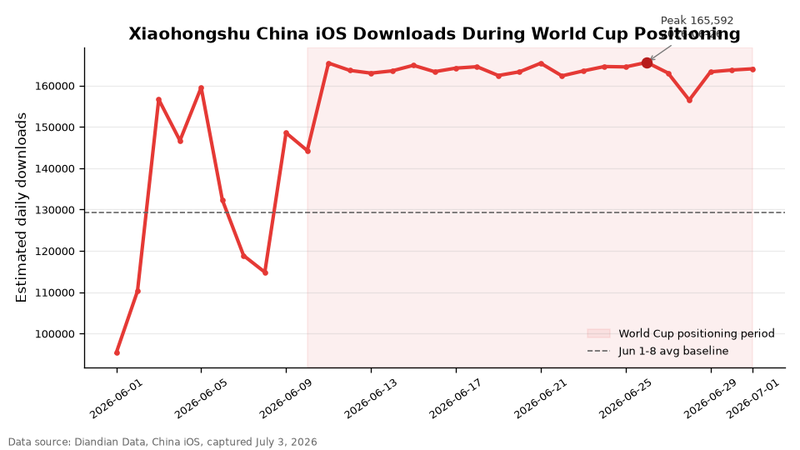
Data source: Diandian Data (diandian.com), China iOS, captured on July 3, 2026.
The Deal: Who Did Xiaohongshu Replace?
Here are the facts:
- Announced: May 28, 2026
- Rights source: Sub-licensed from CCTV (China Central Television)
- Broadcasting lineup: CCTV + Migu + Xiaohongshu
- Replaced: Douyin (TikTok China), which held rights for the 2022 World Cup
- Coverage: App + web + screen casting, all 104 matches free
- Cost: Officially "no higher than previous editions"; industry estimates put it under ¥1 billion (~$140M)
- Companion investments: Fan Zhiyi and Xie Hui as commentators, "Fan Circles" social product, daily "World Cup Chat" show
Key context: Xiaohongshu already has 100 million+ users interested in football. This isn't starting from zero.
But what's truly striking is the evolution of China's World Cup broadcasting landscape:
| Year | Broadcasting Lineup | Key Change |
|---|---|---|
| 2018 | CCTV + Youku + Migu | Youku enters for the first time |
| 2022 | CCTV + Douyin + Migu | Douyin replaces Youku |
| 2026 | CCTV + Xiaohongshu + Migu | Xiaohongshu replaces Douyin |
Every World Cup, a new player buys a ticket. The logic isn't about who has the most money — it's about which platform is hungriest for users at a specific growth stage.
Why Xiaohongshu "Had To" Win the World Cup
A 36Kr report quoted someone close to Xiaohongshu's management:
"Right now, compared to the others, Xiaohongshu needs the World Cup broadcasting rights more. The platform's DAU (170M) has been stuck for a long time."
Translated into growth terms: Xiaohongshu hit a DAU ceiling and needed a massive "event lever" to break through.
Specific targets:
- DAU: Break from 170M to 200M
- MAU: Grow by 50M on top of existing base
- User demographics: Attract a large number of male users (currently ~70% female)
All three targets point to the same question: What kind of content can simultaneously drive acquisition, activation, and demographic expansion?
The answer: the World Cup — the largest attention-aggregation event on the planet.
Why Not Other Sports IPs?
Because the World Cup has two unique properties:
- Universal appeal: Even non-fans watch. It's the ultimate social currency.
- Fragmented consumption: FIFA's 2022 report showed nearly half of Chinese viewers consumed the World Cup through short video and social media in fragmented sessions. Over 70% of 2026 World Cup matches kick off between 6AM and noon Beijing time — the time difference amplifies fragmented consumption even further. This is exactly Xiaohongshu's strength.
Historical Benchmark: Douyin's 2022 World Cup Boom — and Bust
To evaluate whether Xiaohongshu's bet pays off, the best reference is Douyin.
During the 2022 Qatar World Cup:
- Douyin's DAU peaked at 700M (normal baseline: 650-680M)
- Average daily time spent per user exceeded 120 minutes, an all-time high
- Sports-related content engagement surged
But after the tournament? Sports content engagement saw a significant decline.
This reveals a harsh growth truth: peak growth driven by events is mostly "borrowed," not "earned."
The Right Way to Measure: Trend Line Projection
Most analyses make the mistake of simply comparing "pre-event vs. during-event" numbers. That's wrong.
The correct methodology:
- Establish the natural growth baseline: Use the 6-month pre-event trend line with linear regression, project it into the event period
- Calculate excess growth: Actual data minus projected baseline = the true incremental impact of the event
- Track the regression curve: How long until metrics return to baseline? Is the post-event new baseline higher than the old one?
That last question is the key: If the post-event baseline sits above the pre-event baseline, it means the event didn't just bring traffic — it brought real user retention.
Breaking Down Xiaohongshu's World Cup Impact
4.1 Downloads & Rankings
Xiaohongshu has already updated its App Store title to "小红书 – 世界杯直播" (Xiaohongshu – World Cup Live) — a clear ASO strategy signal: capturing search traffic with World Cup keywords.
From an ASO perspective, this move delivers at least three benefits:
- Search exposure: Users searching for "World Cup" or "World Cup live stream" see Xiaohongshu directly
- Conversion lift: The words "World Cup Live" give hesitant users a reason to download
- Brand awareness: Even without downloading, users remember "Xiaohongshu streams the World Cup"
4.2 Demographic Expansion
This is the core payoff of Xiaohongshu's World Cup strategy.
A platform with 70% female users naturally lacks male content consumption scenarios. The World Cup is the shortest-time, largest-scale content lever to attract male users.
But can they retain them? That depends on:
- Whether there's sustained sports content supply post-tournament
- Whether male users can find "their community" on Xiaohongshu
- Whether the recommendation algorithm can match non-sports content with male users
4.3 Fragmented Consumption: Xiaohongshu's Home Turf
The 2026 World Cup time difference is actually a tailwind for Xiaohongshu:
- Over 70% of matches kick off between 6AM and noon Beijing time
- Users won't "sit down and watch the full match" during these hours
- "Scroll and chat," watch highlights, browse discussions — this is exactly Xiaohongshu's usage pattern
CBNData cited FIFA data: nearly half of Chinese viewers consumed the World Cup in fragmented sessions via short video and social media. This means World Cup attention has already shifted from long-form video platforms to community platforms.
4.4 Monetization Signals
Xiaohongshu opened brand partnerships for live event streams for the first time. This sends an important signal:
- Extending from "product seeding" to "event-driven consumption"
- Brands can enter users' match discussion funnels
- The monetization ceiling has been raised by the World Cup
Competitive Comparison: Four Platforms' Sports Content Strategies
| Dimension | Douyin (2022) | Migu | Xiaohongshu (2026) | Bilibili |
|---|---|---|---|---|
| Strategy | Exclusive broadcast rights | Three consecutive deep dives | Community + broadcast | Event-driven UGC |
| Core advantage | Scale dominance | Sports vertical expertise | Community discussion culture | Young user stickiness |
| Key metric | DAU peaked at 700M | Stable sports vertical growth | Target DAU 200M | Active UGC ecosystem |
| Post-event retention | Significant decline | Low ceiling | To be seen | Strong community stickiness |
| User profile | Broad audience | Hardcore fans | Interest-based users (many female) | Gen-Z |
Key insight: Xiaohongshu's differentiation is "community + broadcast," not "pure broadcast." It's betting not on viewing demand, but on post-viewing discussion demand — that's the real battlefield for social platforms.
A sharp analysis from The Paper (澎湃新闻):
"Hardcore fans' social relationship chains, tactical discussion habits, and sense of community belonging have been rooted in established communities like Weibo sports KOLs, Zhibo8, and Dongqiudi for over a decade. Trying to forcibly relocate content consumption habits that male fans have built over ten years, within a one-month tournament window, is no small challenge."
But Xiaohongshu probably doesn't need to poach hardcore fans. What it wants are casual fans and interest-based users — people who watch the World Cup but wouldn't open Dongqiudi every day. That group is far larger than hardcore fans.
Lessons for App Marketers: Event-Driven Growth Methodology
From Xiaohongshu's World Cup play, we can extract four reusable growth methods:
✅ 1. Find Your "Asymmetric Lever"
Xiaohongshu's strength isn't sports content capability — it's community discussion culture. World Cup match discussions happen to need a community-type platform to host them.
Does your app have a similar "asymmetric lever"? Don't shore up weaknesses — find an external event that happens to amplify your existing strengths.
✅ 2. Align ASO with Event Marketing
Xiaohongshu changing its App Store title to "World Cup Live" is textbook event-driven ASO:
- Short-term capture of high-traffic keywords
- Improved search-to-download conversion
- Brand-event association
Does your app have an ASO playbook for major events? Titles, keywords, and screenshots should all move with the event.
✅ 3. Fragmented Consumption Is the Trend, Not the Exception
70% of matches kick off in morning hours → fragmented viewing becomes mainstream → community platforms are naturally suited.
This logic generalizes: Users' time is getting more fragmented. Any product that adapts to fragmented consumption wins.
✅ 4. Community Retention > Traffic Peaks
Xiaohongshu launched "Fan Circles" not for show, but to convert temporary event-period relationships into long-term social connections.
Douyin's 2022 lesson is clear: peaks come and go. Without social relationship retention, peaks are just bubbles.
Does your app have a mechanism to convert "event traffic" into "social assets"?
Final Thoughts
Xiaohongshu's World Cup gamble hasn't reached its conclusion. The tournament is still in progress — final data won't be available until the competition ends.
But one thing is already clear: as AI continues to erode search as an entry point, Xiaohongshu chose a path AI can't easily replicate — real-time, emotional, human-to-human content experiences.
This isn't just a rights purchase. It's a strategic choice by a platform at a growth bottleneck: rather than competing in a saturated market, use an "event-level investment" to unlock new user space.
For app growth professionals, the lesson isn't how much Xiaohongshu spent — it's the systematic methodology of finding leverage, aligning ASO, and designing retention mechanisms.
Want to track how major events impact your app's downloads and rankings? AppFast provides all-in-one app data monitoring — from download trends to keyword rankings to rating changes — helping you quantify the growth impact of every marketing event.